








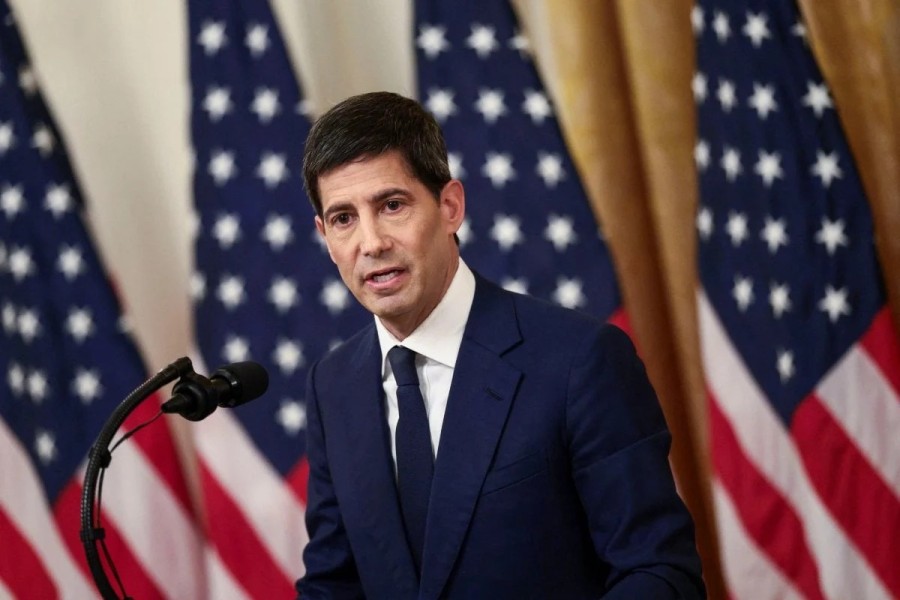


The new policy led by US Federal Reserve Chairman Kevin Warsh is clearly beginning to leave its mark on financial markets, as investors are divided just days before the central bank’s next meeting, amid unusual uncertainty about the anticipated interest rate decision.
Trading in interest rate swaps indicates that traders are giving a probability of approximately 30% for the Federal Reserve to raise interest rates by 25 basis points at its scheduled meeting on July 29, compared to a 70% probability of keeping rates unchanged.
This level of uncertainty ahead of the Fed meeting has been rare in recent years, but many believe it could become the new feature of the Warsh era, who, since taking over the central bank, has abandoned the approach of his predecessors of giving advance signals to the markets about upcoming decisions.
The end of pre-guidance changes the rules of the game.
Jim Bianco, president of Bianco Research and macro strategist, said the absence of forward guidance policy means that markets will get used to seeing similar probabilities of Fed decisions before each meeting.
He explained that percentages such as 20%, 30%, or even 40% for the probability of making a particular decision will become a frequent occurrence, adding that markets are currently going through a transitional phase towards a new approach to reading monetary policy.
The last time markets were this divided was before a Federal Reserve meeting in September 2024, when investors were torn between the prospect of a 25 basis point or 50 basis point interest rate cut.
At that time, former Federal Reserve Chairman Jerome Powell opted to implement the largest cut to support a labor market that was showing signs of slowing down.
Warsh gives policymakers greater flexibility
Since taking over as chairman of the Federal Reserve last May, Warsh has pledged to abandon the traditional policy the bank has followed for years, which is based on advancing markets on the expected path of interest rates.
Warsh believes that issuing such signals may unnecessarily constrain monetary policymakers, especially when economic conditions are changing rapidly.
This change has raised the level of risk for market participants, as the gains for those who succeed in predicting the Fed's decision have become greater, while the losses of investors who bet on the wrong scenario are increasing.
Despite this uncertainty, Warsh has repeatedly stressed that combating inflation remains a top priority, especially after inflation rates have remained above target since the coronavirus pandemic, which has reinforced the market's belief that the Federal Reserve will raise interest rates before the end of the year, while the timing of this move remains a point of contention.
Economists are more confident than the markets.
In contrast, economists seem more confident about the outcome of the upcoming meeting than traders in the markets.
A Bloomberg survey of 76 economists showed that all participants expect the Federal Reserve to keep interest rates unchanged during its July 28-29 meeting, with the interest rate range remaining between 3.5% and 3.75%.
Bond markets briefly embraced this scenario last week, after data showed US consumer prices fell in June for the first time in six years.
But renewed military escalation between the United States and Iran has led to a rise in oil prices again, which has revived concerns about inflation and prompted investors to raise their expectations regarding the possibility of monetary policy tightening.
Market bets shift to September
Interest rate swap markets are currently pricing in a full 25 basis point rate hike at the September meeting.
Current projections also reflect the possibility of more than two interest rate hikes by next March, if inflationary pressures continue to rise.
John Brady, managing director at RJ O'Brien, said he still believes the Federal Reserve will not raise interest rates at next week's meeting.
But he also noted that market movements reflect a closer race than he had anticipated, stressing that investors see the chances of an interest rate hike as much greater than they were a few weeks ago, which increases the anticipation ahead of the Federal Reserve’s expected decision.