













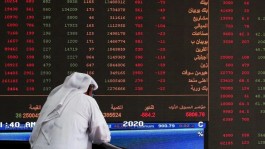






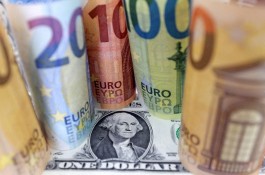

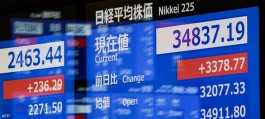




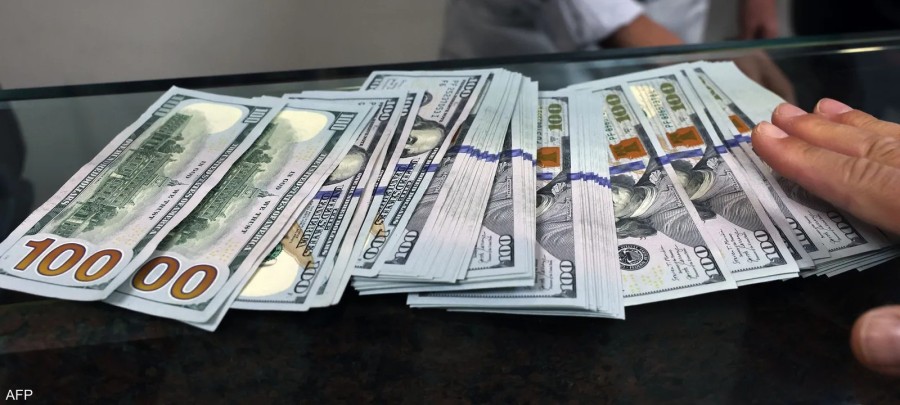
The dollar rose against most major currencies during trading on Monday, jumping to its highest level since before 'Liberation Day', and also jumped to its highest level in 17 months against the euro.
The euro fell to $1.1161 in Asian trading, its lowest level since May 2025, before paring losses slightly to $1.1118, down 0.62%. On Friday, the euro had recorded its fourth consecutive weekly decline against the dollar, its biggest drop in nearly four months.
This comes amid concerns about France's ability to control its budget deficit, coinciding with a sharp sell-off in bond markets last week that raised fears of a return to the sovereign debt crisis atmosphere in the Eurozone.
French government bonds have come under pressure, with rising expectations of higher interest rates and escalating political uncertainty ahead of the 2027 elections, raising doubts about the ability of the Eurozone's second-largest economy to put public finances on a more sustainable path.
The spread between French and German bond yields, considered safe havens, widened to nearly 150 basis points on Friday, the highest level since the eurozone sovereign debt crisis in 2011, before narrowing to 140 basis points. The spread later rose 5 basis points to 145.50 basis points.
Analysts believe that France’s financial problems represent a major challenge in themselves, but the approaching presidential elections and the existence of a divided parliament, which has often proven difficult to reach consensus solutions, make addressing the crisis even more complicated.
The spending cuts, which have already exacerbated the severe funding crisis in the education sector, have sparked public discontent and led to protests across the country.
The dollar is nearing its highest level since Liberation Day.
The dollar index, which measures the performance of the US currency against a basket of six major currencies, rose 0.39% to 102.33, after touching 102.53, its highest level since April 10, 2025.
Analysts believe that the euro's appeal as the main alternative to the dollar had begun to decline after the Federal Reserve raised interest rates in September, but the sharp widening of French bond yield spreads last week dealt an additional blow to the European currency.
Traders are currently pricing in a 78% probability that the Federal Reserve will leave interest rates unchanged in October, compared to 36% a week ago, according to the CME Group's FedWatch tool. Conversely, investors still expect a rate hike in December, along with two more increases during the first half of 2027.
The term “Liberation Day” refers to the sweeping tariff package announced by US President Donald Trump in early April 2025, which triggered a widespread sell-off of US assets. The dollar index was hovering around 104 before the package was announced.
The yen benefits from tighter monetary policy.
The Japanese yen rose 0.10% to 157.67 against the dollar, supported by recent verbal warnings from the Japanese government and authorities about the currency's weakness, as well as benefiting from its status as a safe-haven asset.
Concerns about Japan's fiscal outlook eased after Prime Minister Sanae Takaichi renewed her commitment to fiscal discipline, reassuring investors worried about rising bond yields and deteriorating public finances.
Data released on Friday showed that core annual inflation in the Japanese capital accelerated in September at its fastest pace in 10 months, strengthening the case for the Bank of Japan to continue raising interest rates.

UAE's Mubadala leads a $400 million financing round for German insurance company Wefox
Wefox, an insurance technology company founded by former emp.. Read more

Saudi Arabian Centers distributes dividends to shareholders for the second half of 2022 with a total of 356.25 million riyals
Arabian Centers Company has approved the distribution of cas.. Read more

The largest sovereign funds: "Abu Dhabi Investment Authority" advances to third place globally, with assets of $708.8 billion
The Abu Dhabi Investment Authority has advanced to the third.. Read more
Accumulated losses place Emirati companies on the "second category" screen, pending anonymity
Special Report - (Namazone): A group of companies listed.. Read more

Details 142 Saudi initiative to face the consequences of "Corona" B214 billion riyals
Special Report (Nmazzon): The government announced that.. Read more

Will gold remain a safe haven asset?
Gold has long been a source of controversy and contention am.. Read more
Global trade is expected to decline in the coming months
The economics department of Qatar National Bank (QNB) said t.. Read more

Analysis .. How will major central banks respond to the increasing cases of financial instability?
The global macroeconomic environment is experiencing some of.. Read more

The euro is below the dollar .. the lowest level in 20 years
For the first time in 20 years, the euro fell below $1 on Tu.. Read more

"OPEC"...The pressures of supply shortage will continue next year
OPEC expected global demand for oil to increase next year, b.. Read more
The dollar is approaching its highest levels since what became known as "Liberation Day".

NamaaZone " The Power of Knowledge"


Analysis Service |
Its a free service for technical consultation provided by NamaaZone to the website visitors. |
Open account Request |
NamaaZone provides a range of integrated trading solutions in local and global financial markets |