




























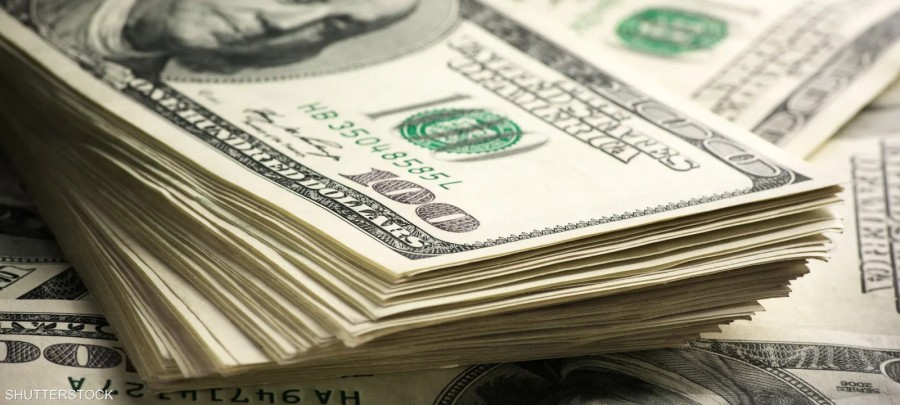


After the US dollar was hit hard in 2025, under pressure from tariffs imposed by President Donald Trump and the US Federal Reserve cutting interest rates three times in a row, the outlook of major Wall Street banks and companies – which did not take into account developments in Venezuela – leans towards a further decline in the dollar in 2026.
Here are Wall Street's top predictions for the greenback:
BNP Paribas
The dollar is expected to perform erratically, with the US currency likely to follow a more balanced trajectory next year, after a year of general decline in 2025. The report indicated that reduced hedging flows and continued inflows into US equities, fueled by artificial intelligence investments, could support the greenback, despite declining demand for Treasury bonds. It also predicted a slight rise in the euro's exchange rate against the dollar, compared to futures levels, as the single European currency could benefit from stronger-than-expected growth in the Eurozone economy.
He also predicted that the greenback would lose momentum against high-yielding emerging market currencies, while maintaining relative strength against Asian currencies.
Morgan Stanley
Although he expects the dollar to continue its decline throughout the first half of 2026, he anticipates a recovery sometime in the second quarter, as its bear market nears its end. He noted that the dollar index is expected to face a volatile year, explaining that the decline and recovery reflect changes in interest rate differentials and the risk premium, which could rise due to concerns about the US labor market, the Federal Reserve's policies, and the path of interest rate cuts, though not to the levels seen earlier in the year. He also expects European currencies to weaken against the dollar as the European Central Bank and the Bank of England cut interest rates.
JP Morgan
He adopts an overall negative outlook for the dollar, albeit less severe and smaller in scope compared to 2025, noting that a combination of the Federal Reserve’s continued concern about the declining labor market and a moderate risk environment that supports a range of high-yielding foreign currencies would lead to a general decline in the dollar, but strong growth in the US economy and continued inflation are curbing the downward trajectory.
He also expects a slight rise in the euro against the dollar, supported by the growth of the eurozone economy and fiscal expansion in Germany, explaining that any rise in the euro against the dollar is expected to be slight compared to 2025, unless US data reflects significant weakness.
In numerical terms, he predicted that the exchange rate of the euro against the dollar would reach $1.18 by the end of the first quarter, and $1.20 for the rest of the year, while the exchange rate of the dollar against the Japanese yen would reach 157 yen by the end of the first quarter, 158 by the end of the quarter ending in June, and 160 and 164 in the third and fourth quarters respectively.
Manpreet Gill, the bank’s chief investment officer for the Middle East, Africa and Europe, said in an interview with Al-Sharq that lower interest rates and the expected decline in the strength of the US dollar will provide a positive environment for risky assets, adding that emerging market bonds are poised to outperform their counterparts in developed countries, supported by higher returns and expectations of a weaker dollar.
Barclays
With the US economy returning to normal growth rates and monetary policy easing, a weaker dollar could support emerging market stocks, which remain cheaper than their developed market counterparts.
UPS
The dollar may come under pressure from an expected US interest rate cut, which would bolster the appeal of the euro, the Australian dollar, and the Norwegian krone at the expense of the greenback. Financial tightening could contribute to increased currency volatility going forward, while higher-yielding currencies are expected to benefit from a wider risk appetite in the foreign exchange market over the next year.
Franklin Templeton
The dollar continues to decline due to factors including the possibility of further interest rate cuts by the Federal Reserve as a result of the slowing labor market, which will support assets denominated in local currencies outside the United States.
Bank of America
A weaker dollar will enhance the competitiveness of American goods and services, which will help support the profit growth of American exporting companies and multinational companies with operations abroad.
City Group
Not all forecasts were negative. This bank maintained its optimistic outlook for the dollar, despite it contradicting the consensus, asserting that it is supported by cyclical, not structural, factors. It anticipates a recovery for the greenback in the first half of 2026, as the US economy resumes its upward trajectory, and predicts that the euro will fall to $1.10 by the middle of next year. The bank also noted that structural mechanisms may exert significant pressure on the dollar in the future, but that this could take years to translate into exchange rate trends.
Deutsche Bank
The bank also predicted that the US dollar would stabilize against the euro at roughly its current level by the end of 2026, supported by the correlation between US stocks and the greenback. The dollar could also benefit from significant inflows driven by the relative and absolute strength of the economy, the fiscal measures under Trump's tax law, the relative easing of tensions with China, massive artificial intelligence investments, and the potential for tariffs to attract foreign direct investment.
Likewise, the impact of Trump’s tax law may not be limited to supporting US stock prices, but may also extend to raising the government debt, which may reduce confidence in the dollar, something that may also be caused by growing doubts about the independence of the Federal Reserve after the appointment of a new president in late May 2026.