
















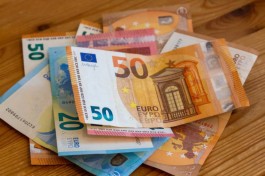


















The euro fell in the European market on Wednesday against a basket of global currencies, resuming its losses that had paused temporarily yesterday against the US dollar, and approaching its lowest levels in 17 months again, due to rising political and financial risks in Europe.
This comes in conjunction with renewed purchases of the US dollar, considered the best investment opportunity in the foreign exchange market, ahead of the release of the minutes of the last meeting of the Federal Reserve, which are expected to contain strong evidence about the path of interest rates during the remainder of this year.
Price overview
Euro exchange rate today: The euro fell against the dollar by about 0.3% to ($1.1228), from today’s opening price of ($1.1258), and recorded a high of ($1.1263).
The euro ended Tuesday's trading session up 0.3% against the dollar, as part of its recovery from a 17-month low of $1.1161.
Apart from buying from low levels, the euro rose thanks to improved French bonds following Marine Le Pen's proposals to cut spending.
French political and financial risks
Political and financial risks in France remain one of the main sources of pressure on the euro, given the continued uncertainty surrounding the political situation and the government's ability to pass deficit reduction plans and control public debt levels.
Markets are also closely monitoring the widening spread between French and German bond yields, as it is seen as an indicator of the rising risk premium associated with French assets.
If political and financial pressures persist or concerns about the sustainability of public finances escalate, this could lead to further pressure on French bonds, which would negatively impact investor confidence in the European currency.
Spain calls for early elections
France is no longer the only source of political concern; Spain has announced early elections to address its housing crisis, adding a new layer of political uncertainty to the Eurozone. Consequently, the pressure on the currency stems from a combination of French financial risks and Spanish political uncertainty.
The European Central Bank's dilemma
Inflation in the eurozone rose sharply in September, driven by the energy price shock linked to the Iran war, increasing pressure on the European Central Bank to continue raising interest rates. However, rising European bond yields and tighter financial conditions are putting the European economy under increasing downward pressure.
Consequently, the European Central Bank faced a difficult equation: high inflation requiring policy tightening, versus increasing financial and political risks requiring greater caution.
US dollar
The dollar index rose 0.25% on Wednesday, resuming gains that had paused temporarily the previous day as part of a correction and profit-taking from 18-month highs, reflecting the renewed rise in the US currency against a basket of major and minor currencies.
Dollar purchases have resumed as one of the most prominent investment opportunities available in the foreign exchange market, supported by strong expectations of a US interest rate hike in December, along with escalating political risks in Europe and the Middle East, which enhances demand for the US currency as a safe haven.
The yield on 10-year US Treasury bonds rose 0.5% on Wednesday, resuming its climb towards its highest levels in 24 years, providing further support for the US dollar exchange rate in the foreign exchange market.
Markets are awaiting the release later today of the minutes from the Federal Reserve’s latest meeting, with expectations that they will contain important signals about the course of US monetary policy in the coming period, particularly regarding the possibility of an additional interest rate hike before the end of this year.
Euro performance forecast
Here at FX News Today, we predict: If the US Federal Reserve's comments come in more hawkish than expected by the markets, the chances of a US interest rate hike in October will increase, which will put further downward pressure on the Euro/US Dollar exchange rate.