



































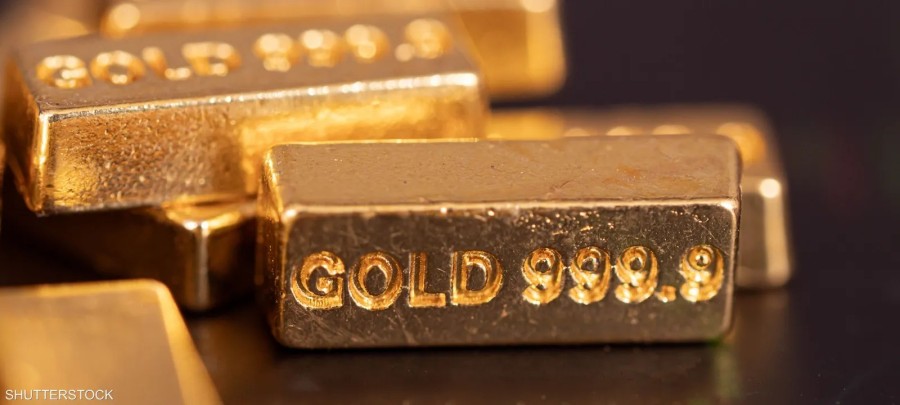


Spot gold prices rose on Thursday after the precious metal hit a six-month low, as investors took advantage of recent sharp declines to buy at lower levels, while markets awaited key US inflation data that could provide further clues about the Federal Reserve’s future monetary policy path.
Technical rebound after a sharp sell-off
Matt Simpson, senior analyst at StoneX, said that gold's approach to the $4,000 level has made this level a clear technical support zone, which may prompt investors who bet on the decline to take profits, and may also encourage buyers who suffered losses during the past period to return to the market.
He added that the US dollar index did not make significant gains following the release of US inflation data on Wednesday, which eased pressure on gold.
He noted that unless the US Producer Price Index data contains strong negative surprises, gold may experience a technical rebound in the near term after the recent wave of sharp declines.
All eyes are on US inflation data.
This rebound came as markets continued to assess the impact of recent US inflation data, which showed that consumer prices in May recorded their fastest annual rise in three years.
The sharp increase in energy prices, resulting from military tensions in the Middle East, has contributed to pushing inflation rates higher, which has reinforced concerns about continued inflationary pressures within the US economy.
Markets are awaiting the release of the US Producer Price Index (PPI) data for May, which is expected to provide a clearer picture of price trends and the future of monetary policy.
Market pricing currently indicates that traders see a greater than 70% probability of the Federal Reserve raising interest rates by next December, according to the US Interest Rate Monitor tool on Investing Saudi Arabia.
The war and oil tensions are adding further pressure.
On the geopolitical front, the United States and Iran exchanged airstrikes for the second day in a row, while US President Donald Trump threatened to carry out further strikes if Tehran does not immediately agree to a peace deal.
In another development that increased market tension, Iran announced the closure of the Strait of Hormuz following the recent US strikes, which pushed oil prices higher during Thursday's trading.
The rise in oil prices is raising concerns about accelerating global inflation, as higher energy costs typically increase price pressures on various economies.
Although gold is traditionally seen as a hedge against inflation, rising interest rates reduce its investment appeal because it does not generate returns like bonds or fixed-income instruments, which explains the continued pressure on the yellow metal despite escalating geopolitical risks.
Gold now
Gold rose 0.5% in spot trading to $4,095.64 an ounce, after having fallen earlier in the session to $4,022.09, its lowest level since November 21.
In contrast, US gold futures for August delivery fell 0.4% to $4,116.20 an ounce.
Performance of other precious metals
Spot silver prices rose 0.4% to $63.95 an ounce.
Platinum also rose by 0.4% to $1,671.09 an ounce.
Meanwhile, palladium jumped 2.9% to $1,248.45 an ounce, recording the strongest performance among precious metals during today's trading.