




























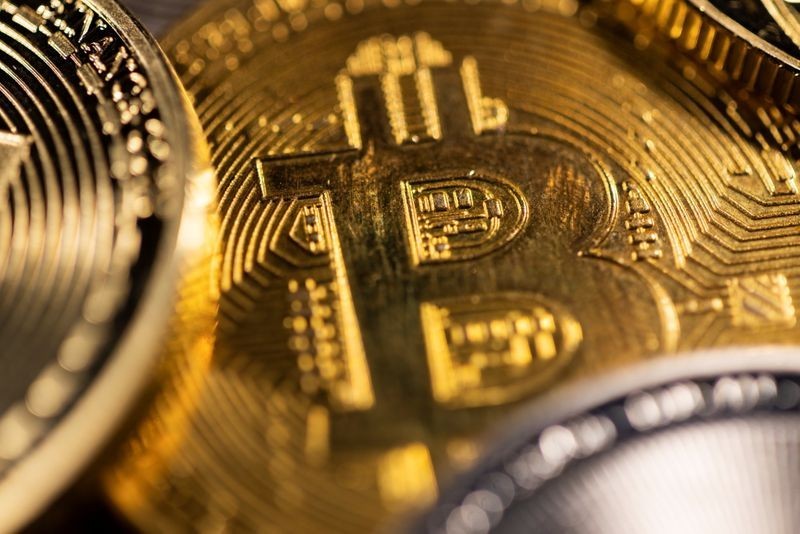


Bitcoin's price fell by about 1.5% last week, while the broader US stock index suffered sharp losses of nearly 10% in just two days, a striking contrast that has even prompted skeptics to reconsider which asset is more volatile.
This divergence came at a time when global markets were experiencing sharp turmoil following statements by US President Donald Trump, yet Bitcoin managed to maintain its stability above the $66,000 level, even reaching nearly $70,000 on Monday, in a performance that stocks could not match.
This relative stability has reignited questions about the nature of Bitcoin, and whether it is still a high-risk asset or has begun to acquire characteristics closer to defensive assets.
Increased institutional interest boosts confidence
This performance did not go unnoticed on Wall Street, where financial institutions and central banks have been studying Bitcoin for years, amid growing interest in it as an independent asset class.
In a notable move, Charles Schwab, which manages nearly $12 trillion in assets, announced plans to launch a live trading service for Bitcoin and Ethereum during the first half of 2026 via a dedicated account.
This move goes beyond exchange-traded funds (ETFs), placing digital currencies alongside stocks and bonds within a single platform used by millions of investors, thus promoting the integration of digital assets into the traditional financial system.
In the same context, Vlad Tenev, CEO of Robinhood, pointed out that market closing times represent an outdated model, stressing that asset tokenization opens the door to a continuously operating financial system similar to the internet.
These statements reflect a deeper shift in thinking about markets, moving from traditional models to more flexible, technology-driven systems. This vision also reinforces the position of digital currencies as a fundamental part of the future financial architecture.
Warnings against excessive optimism
Despite this momentum, Arthur Hayes, co-founder of BitMex and chief investment officer at Mailstrom, believes it is not yet time to fully bet on Bitcoin.
In a recent interview, he explained that he would not invest all his money at the moment, noting that the Federal Reserve has not yet begun injecting sufficient liquidity into the markets. He believes that trade policies, such as tariffs, lead to inflation and negatively impact the economy, which could later prompt the United States to impose restrictions on capital flows.
Hayes expects these restrictions, along with changes in the financial system, to inject significant liquidity into the markets, which could support a long-term rise in Bitcoin.
He set a target price range of between $250,000 and $750,000 by the end of the current cycle, considering that buying Bitcoin is a way to hedge against the erosion of the value of traditional currencies.
But he also warned of the possibility of a temporary market downturn, especially if the war between the United States and Iran continues, which could push the price below $60,000 before any new rise.
History lessons support the bullish scenario.
Research from Mercado Bitcoin, one of the largest cryptocurrency trading platforms in Latin America, indicates that Bitcoin often outperforms gold and stocks during periods following global shocks.
The data showed that Bitcoin initially declines when crises erupt due to investors seeking liquidity, but it rebounds at a stronger pace compared to traditional assets.
The current pattern appears to reflect this behavior, with the price recovering to around $67,300, while stocks continued to decline.
Conversely, some analysts believe that Bitcoin may face a strong downward wave, with technical analysis forecasts indicating a possible price drop to a range between $51,000 and $53,000.
This vision also anticipates a more pessimistic scenario of a sharp decline that could reach 80% or 90% in the coming years, driven by an economic recession and a banking crisis.
Fear indicators are putting pressure on the market
Investor sentiment indicators remain at low levels, with the fear-greed index settling in the extreme fear range for weeks, reflecting a state of persistent anxiety.
Hayes also warned of new risks that could affect the market, most notably the impact of artificial intelligence on the labor market, which could lead to a credit crisis and economic contraction.
This scenario could put pressure on all high-risk assets, including Bitcoin, in the short term.
Between opportunities and risks, an uncertain future.
Charles Schwab's announcement marks a significant turning point for cryptocurrencies, accelerating their integration into the traditional financial system. Including Bitcoin and Ethereum in conventional investment accounts removes barriers between markets and makes these assets more accessible to investors.
This shift could reshape the global investment landscape, giving digital currencies a greater role in investment portfolios.
Bitcoin currently stands between two opposing forces: the first is the expansion of its supporting institutional infrastructure, and the second is a deteriorating and uncertain global economic environment.
Hayes believes the turning point will come when the Federal Reserve is forced to inject liquidity again, which could drive Bitcoin to make significant gains.
Given these circumstances, the markets appear to be pricing in fear at the moment, while history indicates that such moments are often the beginning of strong upward waves.