
































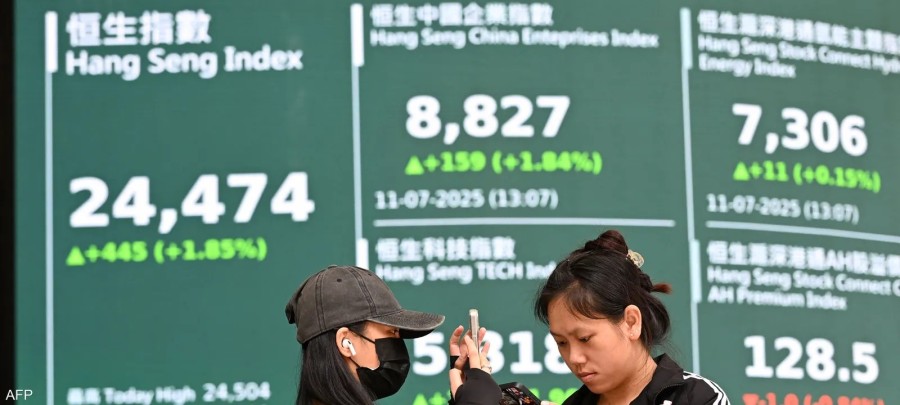


Not long ago, Hong Kong's stock market was a symbol of China's slowdown: deal books were thin, investor sentiment was weak, and bankers were leaving the sector. This year, the picture has completely reversed.
Share sales nearly quadrupled, exceeding $73 billion across initial public offerings (IPOs), private placements, and large-scale deals. For the first time since 2013, Hong Kong became the top location for fundraising in Asia, ranking second globally after the United States. The city spearheaded a deal-making boom on the continent, which included a record year for IPOs in India, alongside strong performances in mainland China and Japan.
Chinese companies fuel a wave of IPOs in Hong Kong
In Hong Kong, Chinese companies spearheaded this momentum with massive deals to support their global expansion plans. Battery maker Contemporary Amperex Technology raised $5.3 billion in the second-largest global IPO this year in May. Electric vehicle manufacturer BYD and Xiaomi, the tech giant whose operations range from electric cars to smartphones, each raised more than $5 billion through private placements.
Deals continued even as the United States began imposing tariffs, at a time when some transactions faced objections from American politicians.
This year has exceeded expectations. We expect volumes to continue rising, but at a more moderate pace, according to James Wang, head of equity capital markets for Asia (excluding Japan) at Goldman Sachs.
Mainland China and Japan are two bright spots in Asia
The recovery was widespread across Asia. The continent was home to four of the world's five largest stock markets, led by Hong Kong, followed by India, mainland China, and Japan. For the first time, four Asian markets were among the top five global markets, according to data compiled by Bloomberg.
Hong Kong's IPO plans also appear robust, with nearly 300 companies expected to list their shares, according to the Hong Kong Stock Exchange. Indicating the frenetic pace of deal-making, the Hong Kong Exchanges & Clearing Ltd., the market regulator, has had to reprimand banks for submitting substandard listing applications. However, this flurry of deals is prompting some investors to exercise caution.
Investor discipline towards valuations and fundamentals will likely be higher after such a strong year, according to Chi Song, senior investment specialist at BNP Paribas Asset Management in Hong Kong.
He explained that the funds managed by his team will selectively participate in high-quality deals related to innovation, the manufacturing of heavy equipment used in robotics, and new consumption trends.
Chinese artificial intelligence is fueling Hong Kong
The current stock sell-off stands in stark contrast to the drought that began in 2022, when borrowing costs soared, tensions between the US and China escalated, and Beijing tightened its grip on domestic tech giants.
This year, Hong Kong's market benefited from China's ambitions in artificial intelligence, advancements in biotechnology, efforts to stimulate domestic demand, and rising gold and aluminum prices. In contrast, share sales remained relatively limited in mainland China, which had outperformed Hong Kong in terms of IPO proceeds in previous years.
Sectors that remain aligned with China’s key strategies will be the most active in IPOs, including technology, advanced manufacturing and robotics, according to Shi Qi, vice president of capital markets at China International Capital Corp.
Potential mega deals in 2026
The upcoming IPOs in Hong Kong are expected to include companies whose shares are not traded on other exchanges, representing a new wave of deals, in addition to the secondary listings of Chinese companies already listed locally, which have dominated the IPO market this year. The biggest potential IPOs include Syngenta Group, the Swiss agricultural technology company owned by China, and AS Watson Group, the health and beauty retailer owned by CK Hutchison Holdings, according to people familiar with the matter. Listings by prominent Chinese artificial intelligence companies are also anticipated.
“If you look at the list of plans, it’s huge,” said Peihao Huang, head of equity capital markets for Asia Pacific at JPMorgan. “The real test will be the market’s ability to absorb this supply, at what valuation and at what pace, as we haven’t seen activity of this magnitude in the past two years.”
Strong stock performance, but limits to optimism
Hong Kong listings have achieved an average weighted average return of nearly 50% this year compared to their listing prices, outperforming the Hang Seng Index. However, the number of deals that actually complete out of the 300 planned for next year, and performance thereafter, will depend largely on the performance of the broader market.
Despite the Hang Seng index rising 29.5% this year, on track for its best performance since 2017, signs of weakness began to emerge in the fourth quarter. Chinese stocks listed in Hong Kong have recently declined due to persistent concerns about the valuations of technology companies and the failure of the fiscal stimulus some investors had hoped for.
Investors are likely to become more cautious about pricing and more selective in their participation, said Rob Chan, head of Asia equity capital markets union at Citigroup.
However, Chan expects 2026 to be a strong year, driven by the expiration of lock-up periods on the sale of shares to existing shareholders, which could fuel large-scale sales, as well as new offerings and the issuance of bonds convertible into shares.
Historic momentum for Indian stock markets
Elsewhere in Asia, India has a large share of the region's deals.
Manan Lahuti, head of capital markets at the law firm Cyril Amarchand Mangaldas, said: “Today we have more deals exceeding $1 billion than ever before. This year alone, we will end up having made or launched more deals than we have in all previous years combined.”
Indian IPOs set a record for the second consecutive year, exceeding $20 billion, thanks to increased investment from mutual funds and individual investors. Existing shareholders also rushed to sell their stakes in large deals.
Among the giants preparing for a Mumbai listing next year is Reliance Industries' Jio Platforms, which could be the largest IPO in the country's history. International companies are also expected to continue taking advantage of India's high valuations to list their local subsidiaries, according to Peter Gointhardt, head of global corporate and investment banking for Asia Pacific at Bank of America.
He added that every multinational company with a large business in India is thinking in one way or another about making that part of its business public.
Concerns about rising ratings
But these same high valuations have raised questions about the sustainability of the IPO boom. Bloomberg data indicates that nearly half of the companies that listed in India this year are currently trading below their offering prices. The MSCI India index has also risen by more than 7% this year, but it has lagged behind the regional benchmark.
James Tom, senior investment manager for Asian equities at Aberdeen Investments, said, “If we see a significant market downturn and contraction, I think that could worry some investors.” Tom avoided participating in the IPO of e-commerce platform Meesho due to its valuation and lack of profitability. The company’s stock closed its first day of trading up more than 50%.
The enthusiasm is also evident in mainland China, which in 2022 overtook the United States to become the world's largest stock market before undergoing a self-imposed tightening that began the following year. Individual investors have been aggressively buying into the initial public offerings (IPOs) of Chinese chipmakers, which aligns with Beijing's goal of achieving technological self-sufficiency. Shares of Moore Threads Technology surged more than 400% in their Shanghai debut.
All of this, of course, could be undone at any time by developments beyond the control of those making the deals, such as geopolitical factors.
John Lee, co-head of Asian country coverage at UBS Group, said: It's difficult to say for sure whether IPO fundraising will surpass this year in 2026. But at least in the first half, volumes are likely to be similar or higher.