












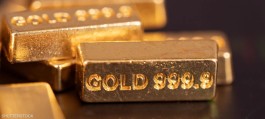










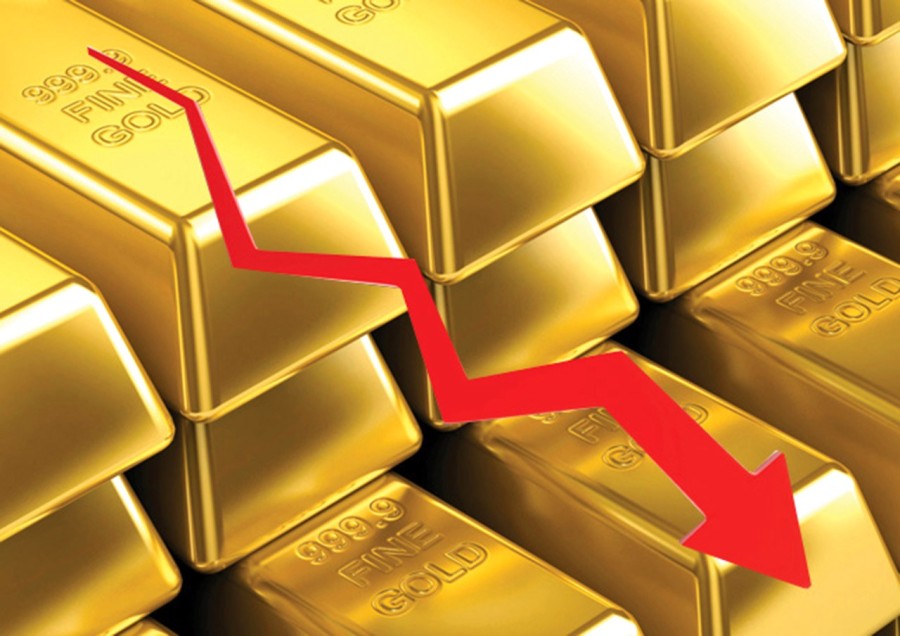


Gold prices suffered heavy losses during the European session, with spot gold falling to $4,671 an ounce, a 3% drop. Later, spot prices declined to $4,685 an ounce, a loss exceeding 4%.
The sharp rise comes as oil prices surge amid the escalating US-Israeli war on Iran, which continues to target oil facilities in the world’s largest oil-exporting region.
The United States and Israel launched strikes against the South Pars gas field, the world's largest natural gas field, which straddles the border between Iran and Qatar. Iran continued to target several oil facilities in the region. As a result, Brent crude futures reached $119 per barrel and had fallen slightly to $114 per barrel by the time of writing.
In light of the recent war, an inverse relationship between gold and oil has emerged. As oil prices rise, the market anticipates a sharp increase in global inflation, forcing central banks to maintain high interest rates, and potentially, in a worst-case scenario, even raise them. In a high-interest-rate environment, gold prices do not thrive, as the US dollar strengthens, and gold loses its luster. Interest rate cuts were a cornerstone of the market's historic gold rally.
The Federal Reserve chairman quietly announces a disaster facing the US economy.
Jerome Powell said, What worries many members of the Federal Reserve is the very weak level of job creation, especially according to the data. He continued, If you calculate the number of jobs added after accounting for adjustments and corrections, the net job gains in the U.S. economy over the last six months are zero in the private sector.
Markets were shocked by the Fed's statement that the US economy is not creating any jobs at all.
There was also one member of the Federal Reserve who believed that interest rates could rise as the Middle East conflict intensified.
This forecast marks the first time in two and a half years that a Federal Reserve official has recorded an interest rate hike, as the war with Iran and the resulting surge in oil prices enter their third week.
Most Federal Reserve policymakers still expect the next move to be an interest rate cut this year, consistent with their December projections. The Fed kept interest rates unchanged on Wednesday in the 3.50%-3.75% range.
For 2026, seven of the 19 Federal Reserve policymakers expect interest rates to remain unchanged by year-end. Seven others believe a single quarter-point cut is necessary this year, while five anticipate at least two cuts will be needed.
Gold's technical collapse
The strongest trend: relentless decline
Current trend: Clearly bearish — price below all major moving averages, momentum indicators confirm sellers are in control.
Oversold signals: The Relative Strength Index (RSI) is at 12.76 (very oversold), and the price is below the lower Bollinger Band, which supports the possibility of a temporary bounce.
Breakdown confirmed: The SuperTrend indicator and Ichimoku Cloud reflect a clear bearish structure, with successive resistances between $4,757 and $4,811.
Strongest trading scenarios
When to enter? The ideal sell is on a weak bounce towards $4,757-$4,811 (strong Fibonacci resistance zone, SuperTrend, previous peak).
Trade management: If the first target is achieved, move the stop loss to the entry point, and with the second target use a trailing stop according to the SuperTrend hourly rate.
When should you move away? The $4,670-$4,725 area is considered a no-trade (high risk/no clear opportunities).
Key technical signals
Last hour candle: Strong bearish momentum with a long lower tail (potential temporary profit-taking/mild bounce).
The gap from the averages: The price is 2.9% below the 20-hour average and 5% below the 50-hour average — an exaggerated extension that is often followed by a bounce, however limited.
Risks for speculators: Any weak bounce towards 4,750 could turn into a buyer's trap before a new wave of selling.
Key lessons for the investor
The trend is oversold: Despite indicators reaching significant oversold levels, it is not advisable to chase buying until reliable reversal signals appear above $4,785.
Selling on every bounce towards resistance is the most appropriate strategy at the moment, but risk management is essential to avoid sudden bounces.
Economic background and influential markets
Today's Federal Reserve meeting: The interest rate decision will be a major driver of gold prices, especially with expectations of a rate hold at 3.75%.
Recent US employment data: An unexpected drop in jobs, further negative pressure on the dollar, could temporarily support a gold rebound.
Gold production costs: Mining companies report rising operating costs, which could support gold in the medium term if the market stabilizes.
Summary of education:
In strong bear markets, the best opportunities are often to sell on a bounce towards resistance, not to buy directly at oversold levels. Learn to recognize oversold zones, but don't ignore the larger trend!