









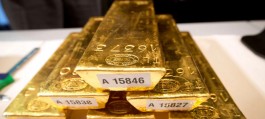








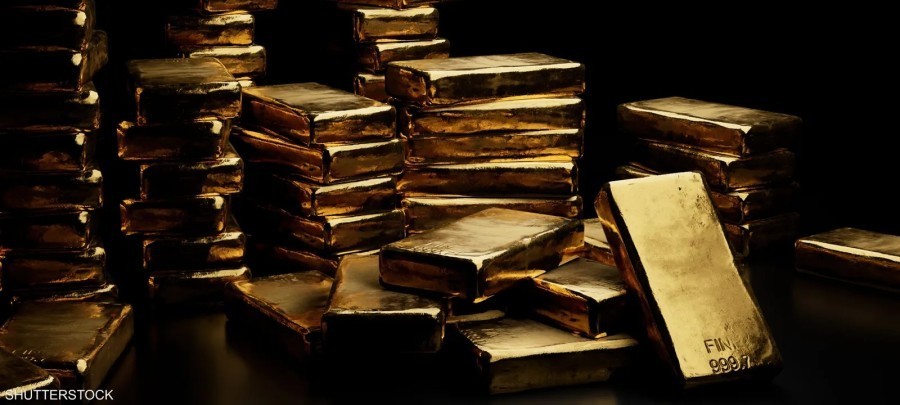


Gold prices were steady in Asian trading on Monday, as the precious metal found only limited relief from ongoing uncertainty over the Middle East war and the path of interest rates.
The yellow metal had suffered two consecutive months of losses, as concerns about its inflationary effects largely outweighed demand for the safe haven in the wake of the US-Iran war.
Spot gold was steady at $4,612.98 an ounce by 08:18 Saudi time, while gold futures fell 0.4% to $4,624.14 an ounce.
Other precious metals were also positive. Spot silver rose 0.4% to $75.6945 an ounce, while spot platinum climbed 0.9% to $2,010.0 an ounce.
Uncertainty continues regarding Iran following Trump's announcement of Operation Hormuz.
US President Donald Trump announced on Sunday evening an operation to help commercial ships pass through the Strait of Hormuz.
Trump did not provide clear details about what the operation would entail. Separately, U.S. Central Command said the operation would involve a further military deployment—of ships and personnel—to the Middle East.
Iranian officials warned that any US intervention in the Strait of Hormuz would be considered a violation of the fragile ceasefire between the two countries. Separately, the Iranian Foreign Ministry said it had received the US response to its 14-point plan for reopening the Strait of Hormuz and ending the war, according to state media reports.
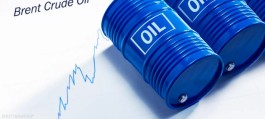
But there appears to be no clear near-term path to ending the conflict and reopening Hormuz - a trend that is expected to keep oil prices high and inflation concerns strong.
Kashkari of the Federal Reserve does not rule out the possibility of raising interest rates.
Minneapolis Federal Reserve President Neel Kashkari said on Sunday that a prolonged Iranian war poses greater inflationary and economic risks.
Kashkari also warned that uncertainty about the war limits the Federal Reserve's ability to guide interest rates, and did not rule out the possibility of raising interest rates due to inflationary risks.
Reports showed that Kashkari was among an unusually large number of policymakers who opposed the Federal Reserve's move toward easing during last week's meeting, amid growing concerns about rising energy-driven inflation.
Aside from the Federal Reserve, several other major central banks have signaled a possible interest rate hike or have already begun raising rates in response to the Iran crisis. The Bank of Japan, the European Central Bank, and the Bank of England all indicated the possibility of a rate increase last week, while the Reserve Bank of Australia is widely expected to raise interest rates on Tuesday.
High interest rates bode badly for non-yielding assets such as gold, as they increase the opportunity cost of investing in that sector.