
























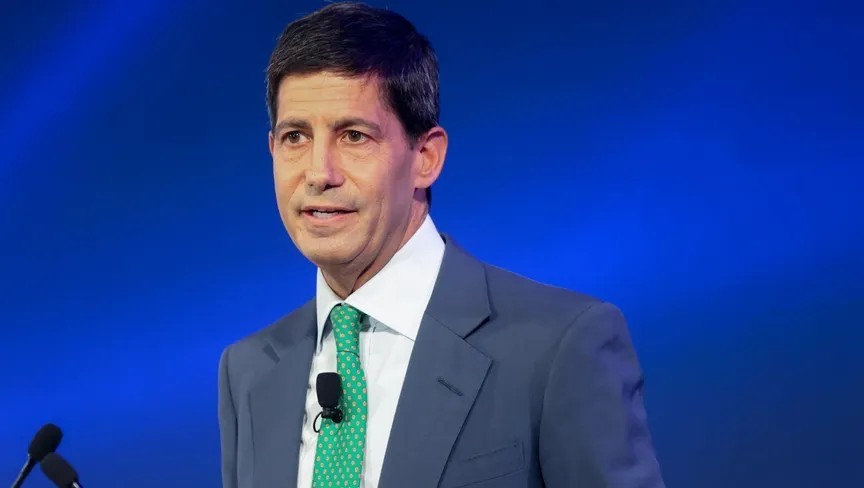


US Federal Reserve Chairman Kevin Warsh stressed that the slowdown in inflation during June does not mean the end of the battle against rising prices, hinting for the first time since taking office at how the central bank might respond if inflationary pressures persist.
During a nearly three-hour hearing before Congress, Warsh faced questions from lawmakers about his plan to deliver on his repeated promise to stabilize prices, after years in which the Federal Reserve failed to bring inflation back to its 2% target.
Although he avoided giving a direct indication of an imminent tightening of monetary policy, he made it clear that interest rates remain one of the main tools available to the central bank to combat inflation.
Warsh said: We have the tools to achieve this, adding: In the coming period, I will ask our colleagues to have an in-depth discussion about the size and timing of the use of these tools, referring to the monetary policy tools available to the Federal Reserve.
First hint of a possible interest rate hike
Economists believe that Warsh's remarks did not go so far as to indicate an imminent interest rate hike, but they represent his clearest acknowledgment yet that monetary policy may need to be tightened further if inflation remains high.
Ulu Sonola, head of US economics at Fitch Ratings, said that these statements represent the closest Warsh has come to acknowledging the possibility of raising interest rates in response to persistently high inflation, without explicitly stating so.
Economists at Goldman Sachs, in a note to clients, also considered that the Federal Reserve chairman’s remarks contained indications of his vision for how to deal with supply-side shock inflation, one of the most complex types of inflation for central banks.
The end of forward guidance... and a new approach for the Federal Reserve
US President Donald Trump had nominated Kevin Warsh to head the Federal Reserve, at a time when he continued to demand lower borrowing costs.
Since taking office in May, Warsh has pledged to abandon the policy of forward guidance, through which the Federal Reserve used to send signals to markets about the expected path of interest rates.
Warsh and several central bank officials believe this approach restricts the ability of monetary policymakers to act when economic conditions change suddenly.
For this reason, since taking office, he has been careful to avoid giving any advance prediction about how the Federal Reserve would react if inflation did not decline, although some of his colleagues within the central bank have spoken openly about the possibility of raising interest rates.
Economists are divided over the implications of the statements.
Not all economists were convinced that Warsh's remarks represented a genuine shift in his position. Jason Furman, former chief economist in the Obama administration and professor of economics at Harvard University's Kennedy School, said the Federal Reserve chair maintained his usual approach and offered no new guidance during the hearing.
He added: Anyone who thinks they have heard hints about Warsh's future plans is misunderstanding his statements, stressing that he does not see any clear indication at the moment, because the Federal Reserve chairman has not yet decided on the path he will take.
In contrast, market participants scaled back their bets on an interest rate hike at the July meeting, after data released earlier on Tuesday showed consumer prices fell in June for the first time in six years, coinciding with a temporary lull in the war between the United States and Iran before renewed escalation later.
The core inflation index, which excludes the more volatile food and energy prices, also remained stable, showing no increase.
Inflation data eased the pressure... but the job is not done.
Stephen Englander, global head of G10 currency research at Standard Chartered, said weak inflation data made the congressional hearing easier for Warsh.
Although the inflation figures came in lower than expected and eased the political pressure on him, members of Congress continued to question him about how he intended to bring inflation back to the target level.
Warsh explained that the June inflation reading was better than expected, but still far from achieving the ultimate goal.
He said: I will not stand here and say that the mission has been accomplished, adding: We still have a lot of work ahead of us.
Kathy Bostijancic, senior economist at Nationwide, saw the overall tone of Warsh's remarks as reflecting a clear inclination towards a tighter monetary policy, noting that his comments suggested he might support raising interest rates at some point if inflation remained persistently high.
Plan to restructure the Federal Reserve
Warsh also used the hearing to unveil his broader vision for bringing about changes within the Federal Reserve, pledging to make what he called a change of approach by forming five new task forces to review and possibly overhaul key aspects of the monetary policy-making mechanism.
At the same time, he affirmed his commitment to maintaining the independence of the central bank, stressing that he would keep policy free from partisan considerations and would not hesitate to take the measures he deemed necessary to protect the economy.
Warsh concluded his remarks by saying: Our mission, and this is my commitment to you, is to bring prices that are stuck at high levels back to stable levels.