































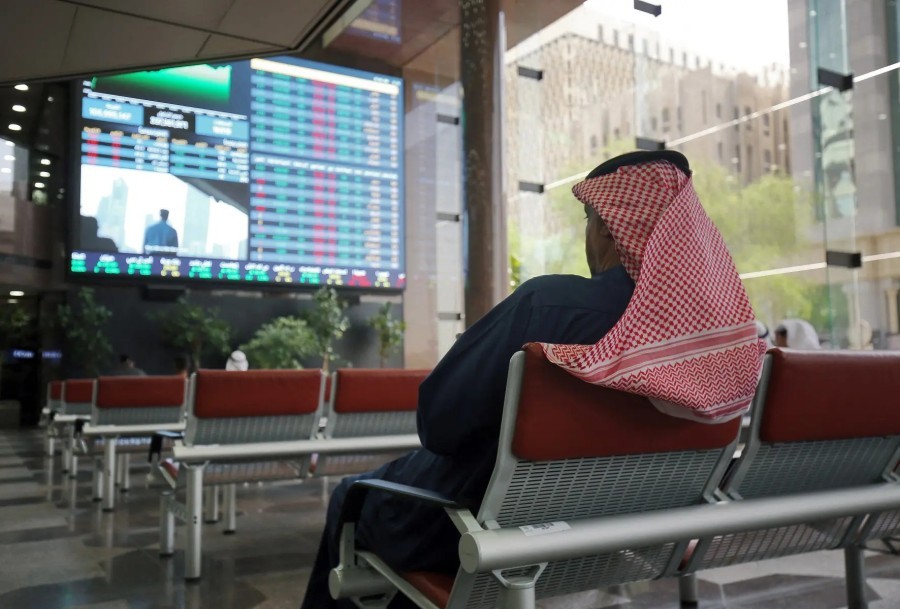


The Saudi stock market index, TASI, witnessed a quiet start to the week, moving within a narrow range near the 11,078 point level, amid continued anticipation among investors, with varying performance across sectors and stocks, and the index remaining below several important technical averages.
Data and analysis indicate that the market is still moving within a consolidation phase that tends to be negative in the short and medium term, with selling pressures continuing despite attempts to stabilize above the 11,000 point level.
The Saudi market is moving cautiously amid a fragile balance.
According to real-time data from the WarrenAI platform, the Saudi market's general index, TASI, is moving within a very narrow range around the 11,078 point level during trading on Monday, recording a marginal increase of no more than 0.01%.
This performance reflects a state of anticipation and caution among investors, at a time when the market is trying to absorb the local and global factors affecting risk appetite.
The session witnessed trading worth approximately 369.5 million riyals through the execution of deals on more than 20.63 million shares, indicating the continuation of trading activity despite the absence of a clear direction for the index.
Market data also showed that shares of 159 companies declined compared to only 87 companies that rose, while shares of 24 companies remained unchanged, reflecting the market's continued tendency towards selling pressure despite the index remaining close to the levels of the previous session.
Some sectors are declining while others are trying to hold on.
At the sector level, the transportation sector topped the list of the most declining sectors after it fell by 0.93%, mainly affected by the decline in Flynas shares by 1.89% to settle at a level of 57.1 riyals.
The healthcare sector also declined by 0.73%, while the applications and technology services sector fell by 0.35%, reflecting continued profit-taking in some sectors that had made gains in previous periods.
In contrast, the luxury goods retail and distribution sector managed to top the list of winning sectors with an increase of 0.55%, supported by a rise in Sinomy Retail shares by 1.5%.
The pharmaceutical sector recorded gains of 0.39%, while the utilities sector rose by 0.25%, indicating some positive pockets within the market despite continued general pressures.
As for stocks, the fish stock led the gainers during early trading after it jumped by 3.2% to a level of 46.4 riyals, followed by the Tabuk Agricultural stock with an increase of 3.12%, then the Saudi Energy stock which rose by 2.69% to reach 18.3 riyals.
A technical analysis reveals continued downward pressures
Data reveals that the technical picture for the Saudi general index still tends towards negativity in the short and medium term.
The index is currently trading below its 5-day moving average of 11,107 points, and is also moving below its 10-day moving average of 11,090 points.
The 50-day moving average is at 11,139 points, which is about 62 points higher than the current index level, confirming the continuation of medium-term selling pressures and the market’s failure so far to regain upward momentum.
These data indicate that the current movements appear to be more of a consolidation or breather phase within a medium-term downtrend, rather than the beginning of a new and certain upward wave.
The index’s annual performance also reinforces this reading, as its gains over the last 12 months have not exceeded only about 4.8%, while it is still far from its annual peak of 11,781 points.
Key technical levels being watched by the markets
Technical analysis from WarrenAI shows that the index is currently moving near a key pivot point at the 11075 level, an area analysts describe as the decision zone.
The first nearest support levels are between 11066 and 11069 points, while one of the most important technical support levels is at 10893 points.
On the upside, the first resistance appears between 11088 and 11091 points, followed by a more significant resistance range between 11100 and 11150 points.
The analysis reveals that the index's ability to break through this range and hold above it would be the first serious technical indication of a decline in selling pressure and a return of positive momentum.
Conversely, a clear break below the 11060 point level could send the index back to retest the 10900 point area.
Momentum indicators still favor caution.
Momentum indicators reveal a continued short-term negative market bias.
The Relative Strength Index (RSI) is moving near the 41-point level, which reflects downward momentum without reaching a fully oversold state.
The MACD indicator is also still in the negative zone, confirming the continued dominance of sellers over the index's immediate movement.
Meanwhile, other indicators such as Stochastic and Williams %R are showing relatively high readings, suggesting that any short-term rebound may face quick profit-taking.
WarrenAI’s analytical models classify the hourly and five-hour timeframes as strong sells, while the daily and weekly indicators take a more neutral stance with some limited positive signals in the longer term.
What does the current picture mean for investors?
A comprehensive reading of WarrenAI data indicates that the Saudi market is still moving within a range of fluctuations that tend towards the negative, with short-term selling pressures continuing.
But at the same time, there are no signs yet confirming the start of a new and violent downward wave, which makes the market closer to a stage of rebuilding balance and waiting for new catalysts.
The 11100 to 11150 point level remains the most important area for buyers, while the 11060 point level remains the main line of defense that traders are watching to determine the direction of the next move.