
















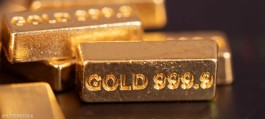













Gold prices fell to their lowest level in about a month and a half during trading on Wednesday, after the strength of the US dollar and rising Treasury bond yields outweighed cautious optimism about the possibility of reaching a peace agreement between the United States and Iran.
The strong dollar and high yields are making their mark.
Tim Waterer, chief market analyst at KCM Trade, said gold has clearly begun to lose momentum amid rising U.S. bond yields and a stronger dollar, driven by a shift in investor expectations toward a more hawkish monetary policy from the Federal Reserve.
The US dollar held near its highest level in six weeks, making dollar-denominated gold more expensive for investors holding other currencies, thus reducing the precious metal's global appeal.
Meanwhile, the yield on 10-year U.S. Treasury bonds has stabilized near its highest level in more than a year, increasing the opportunity cost of holding gold, which does not provide a periodic return like bonds.
US messages regarding Iran increase market uncertainty
Statements from the US administration regarding Iran continue to carry mixed signals, adding uncertainty to financial markets.
While US President Donald Trump hinted at the possibility of Washington launching a military strike against Tehran if negotiations fail, Vice President JD Vance stressed that both sides are making progress and do not want to return to military confrontation.
This divergence reflects the fragility of the diplomatic path and makes investors more cautious in assessing the chances of reaching a lasting agreement that restores stability to the region and eases pressure on global energy markets.
The Federal Reserve does not rule out keeping interest rates high.
Anna Paulson, president of the Federal Reserve Bank of Philadelphia, said the current level of interest rates is appropriate at the moment and is helping to curb inflation, which remains above target levels.
She added that it is healthy for investors to start studying scenarios that may require raising interest rates again if price pressures continue to escalate.
A Reuters poll also showed that most economists now expect the Federal Reserve to refrain from cutting interest rates during 2026, postponing expectations of monetary easing until next year in the hope that the current wave of inflation is temporary.
Investors are awaiting the release of the minutes from the Federal Reserve's latest Open Market Committee meeting later today, looking for clearer signals about the direction of US monetary policy going forward.
Traders will try to gauge how willing policymakers are to keep interest rates high for longer, or even consider raising them if inflationary pressures related to rising energy prices persist.
This report could be a decisive factor in determining the future direction of gold, the dollar, and bond yields in the coming days.
Gold now
The price of gold in spot trading fell 0.2% to $4,472.09 an ounce, after earlier in the session hitting its weakest level since March 30.
US gold futures for June delivery also fell by 0.8% to $4,475 an ounce, continuing the downward trend the precious metal has been experiencing in recent days.
Other precious metals move in the opposite direction.
Unlike gold, silver prices rose by 1.1% to $74.64 an ounce.
Platinum also rose 0.2% to $1,925.30 an ounce, while palladium climbed 0.9% to $1,366 an ounce.