





























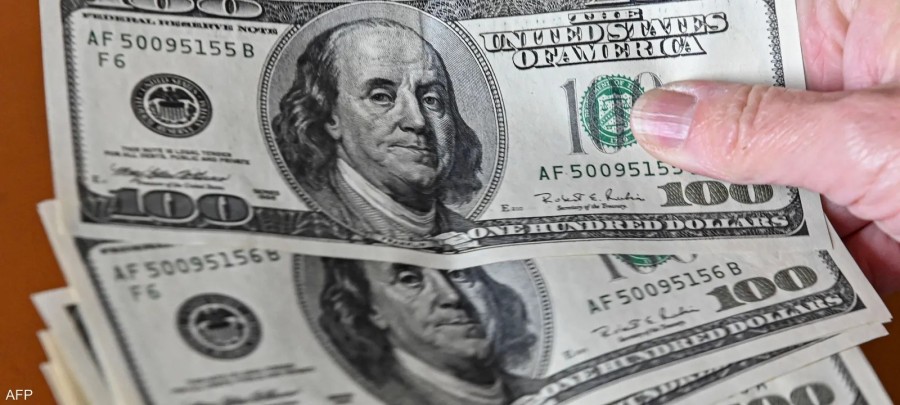


The US dollar rose to its highest level in a week against major currencies during trading on Monday, before paring some of its gains, amid escalating tensions between the United States and Iran and fading hopes for a Middle East peace agreement, prompting investors to return to safe-haven assets.
This move came after the United States announced on Sunday that it had seized an Iranian cargo ship that attempted to break the blockade, while Tehran responded by threatening retaliatory measures, raising fears of a resumption of military confrontations.
Iran also announced its refusal to participate in a new round of negotiations that Washington had hoped to launch before the end of the two-week truce on Tuesday, which increased anxiety in the markets.
Currency movements reflect continued caution
Sharwa Chanana, chief investment strategist at Saxo, noted that the weekend escalation brought back the geopolitical risk premium to the markets, at a time when markets had already begun pricing in potential gains from peace.
She added that rising oil prices are not just an energy issue, but also have an impact on economic growth and the trajectory of interest rates, complicating the global financial landscape.
The euro fell to $1.1757 after hitting a one-week low of $1.1729, while sterling slipped 0.11% to $1.3503 and the risk-sensitive Australian dollar fell 0.27% to $0.7148.
In contrast, the dollar index settled at 98.30, near its highest level in a week, recovering some of its recent losses.
Cautious optimism despite setbacks
Despite these moves, analysts pointed out that the dollar's retreat from its session peak reflects a continued optimism about the possibility of reaching a diplomatic solution, despite recent setbacks.
Chris Weston, head of research at Pepperstone, explained that markets began the week on a cautious note, but movements remain orderly and do not indicate a sharp volatility shock.
He added that investors realize that the path to reaching an agreement will not be smooth, and that sudden changes in sentiment are not surprising in this type of crisis.
The Strait of Hormuz is at the heart of the crisis.
As the war entered its eighth week, the energy crisis took center stage, with the de facto closure of the Strait of Hormuz leading to one of the biggest supply shocks in history, given that about one-fifth of the world’s oil shipments pass through this waterway.
While the United States continues to impose a blockade on Iranian ports, Tehran has lifted the blockade on navigation in the Strait and then reimposed it, further complicating the situation.
This situation pushed oil prices up again, with Brent crude jumping more than 5% to $95.53 a barrel, while West Texas Intermediate crude rose more than 6% to $89.08.
Negative outlook for high-risk assets
Analysts believe that the fate of the markets remains closely linked to developments in the Strait of Hormuz, as the prospects for resuming negotiations between Washington and Tehran before the end of the truce appear weak at the moment.
Nick Twidall, chief market strategist at ATFX Global, noted that markets could see further declines in high-risk assets during the coming sessions, given the continued uncertainty.
In a related context, the New Zealand dollar fell slightly to $0.5872, while the Japanese yen dropped to 158.96 against the dollar, below the 160 level that worries markets about the possibility of Japanese authorities intervening to support the currency.
Investors are also focused on the Bank of Japan's upcoming meeting later this month, where Governor Kazuo Ueda has refrained from giving clear signals about raising interest rates in April, amid the uncertainty imposed by the war.
However, his recent comments following the IMF meetings showed a more hawkish tone, suggesting that steps could be taken to raise interest rates by June, if economic conditions stabilize.