







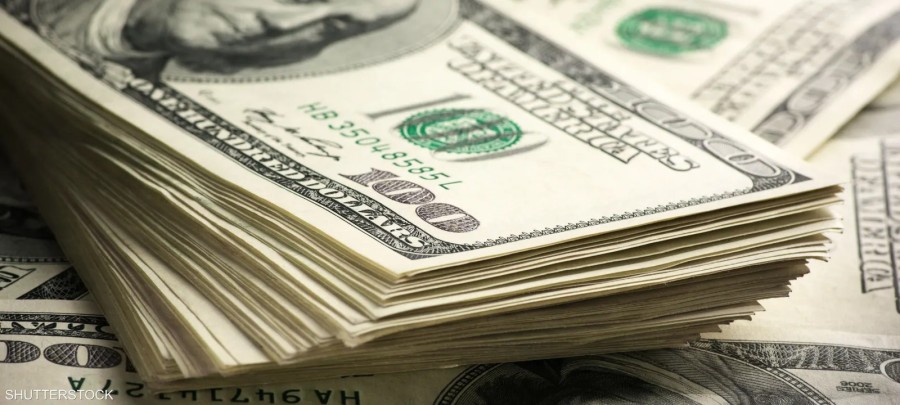
The US dollar rose slightly on Thursday, but remained below its six-week high, amid growing hopes that Washington is nearing an agreement with Tehran to end the war in the Middle East, limiting gains for the US currency.
US President Donald Trump said on Wednesday that negotiations with Iran had entered their final stages, while simultaneously warning of further attacks if Tehran did not agree to a deal.
The dollar, considered a safe haven for investors, rose 0.1% against the Japanese yen to 159.06 yen, after recording its first decline against the Japanese currency in eight sessions on Wednesday.
The yen also received additional support following hawkish comments from Junko Koida, a member of the Bank of Japan's board of directors, who said the central bank needs to continue raising interest rates as core inflation stabilizes near its 2% target.
In contrast, the euro fell 0.2% to $1.16005, after dropping on Wednesday to its weakest level since April 7 at $1.1583 before rebounding.
The pressure on the euro came after data showed that economic activity in France contracted in May at its fastest pace in five and a half years.
Kenneth Burrow, head of currency and interest rate research at Societe Generale, said that “the French purchasing managers’ data were very bad, but the European Central Bank seems determined to raise interest rates,” in explaining the weakness of the euro.
Traders are also awaiting the release of the Eurozone Composite Purchasing Managers’ Index (PMI) data later today.
The British pound fell 0.1% to $1.3421.
The dollar index, which measures the performance of the US currency against a basket of major currencies, rose 0.2% to 99.295 points, but remained below Wednesday's peak of 99.472 points, its strongest since April 7.
Joseph Capurso, head of currency strategy at Commonwealth Bank of Australia, said that safe-haven flows have reversed due to positive news regarding the war with Iran.
But he added that the United States might resort to military escalation in order to strengthen its negotiating position, despite the existence of internal political motives pushing it towards peace.
Investors are focusing on the potential inflationary impact of rising energy prices as the Strait of Hormuz remains partially closed to shipping traffic.
Currency analysts at Commerzbank said some central banks might consider the current inflation shock “temporary” if the strait reopens in the coming days, but they believe this assessment would be wrong because it does not take into account the decline in purchasing power.
They added that currencies could benefit in countries whose central banks are slow to characterize rising prices as temporary, while the possibility of monetary policy tightening remains.
Minutes from the Federal Reserve's April meeting, released Wednesday, also showed officials growing concern about inflation, with more of them open to the possibility of needing to raise interest rates.
In other markets, the Australian dollar fell after a surprise jump in the unemployment rate to its highest level since 2021, easing expectations of further interest rate hikes by the Reserve Bank of Australia.
The Australian dollar fell 0.55% to US$0.71105, after traders reduced their bets on monetary policy tightening this year.
Westpac economist Ryan Wells said expectations for a rate hold at the June meeting have become “high confidence,” but noted that inflation remains the central bank’s biggest challenge.
UAE's Mubadala leads a $400 million financing round for German insurance company Wefox
Wefox, an insurance technology company founded by former emp.. Read more

Saudi Arabian Centers distributes dividends to shareholders for the second half of 2022 with a total of 356.25 million riyals
Arabian Centers Company has approved the distribution of cas.. Read more

The largest sovereign funds: "Abu Dhabi Investment Authority" advances to third place globally, with assets of $708.8 billion
The Abu Dhabi Investment Authority has advanced to the third.. Read more
Accumulated losses place Emirati companies on the "second category" screen, pending anonymity
Special Report - (Namazone): A group of companies listed.. Read more

Details 142 Saudi initiative to face the consequences of "Corona" B214 billion riyals
Special Report (Nmazzon): The government announced that.. Read more

Will gold remain a safe haven asset?
Gold has long been a source of controversy and contention am.. Read more
Global trade is expected to decline in the coming months
The economics department of Qatar National Bank (QNB) said t.. Read more

Analysis .. How will major central banks respond to the increasing cases of financial instability?
The global macroeconomic environment is experiencing some of.. Read more
The euro is below the dollar .. the lowest level in 20 years
For the first time in 20 years, the euro fell below $1 on Tu.. Read more
"OPEC"...The pressures of supply shortage will continue next year
OPEC expected global demand for oil to increase next year, b.. Read more
The dollar is rising slightly but remains below its six-week high.

NamaaZone " The Power of Knowledge"


Analysis Service |
Its a free service for technical consultation provided by NamaaZone to the website visitors. |
Open account Request |
NamaaZone provides a range of integrated trading solutions in local and global financial markets |