




































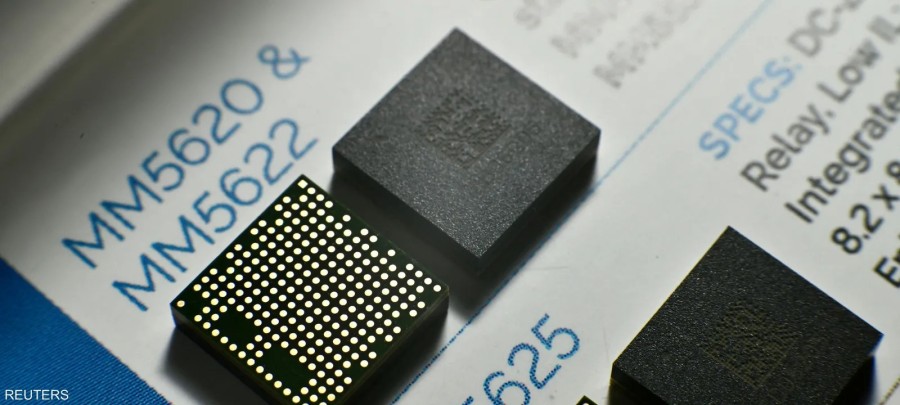


Shares of U.S. semiconductor companies rose in pre-market trading on Thursday after President Trump announced that Apple had agreed to collaborate with Intel to design and manufacture its chips domestically.
Intel shares jumped 8.90% in premarket trading by 1:01 PM. Nvidia rose 1.20%, while Advanced Micro Devices and Broadcom each climbed around 3%. ARM Holdings, Microchip, Applied Materials, and Micron Technology all gained between 2.80% and 5%. Marvell Technology surged 5.80%, and Qualcomm added 2.90%.
As for exchange-traded funds (ETFs), the iShares Semiconductor ETF rose by 3.90%, the VanEck Semiconductor ETF gained 3.30%, and the Roundhill Memory ETF jumped by 6.20%.
Trump announced this in a social media post on Wednesday, writing on Truth Social: “Apple has agreed to work with Intel to design and build its chips in America,” without providing further details.
Trump presented this move as part of his administration’s broader efforts to bring semiconductor manufacturing back to the United States, citing Intel’s existing partnerships with Nvidia and Elon Musk’s TerraFab project as examples.
Trump also noted that the federal government's 10% stake in Intel, acquired earlier this year, had increased in value to $60 billion from $10 billion. The Wall Street Journal reported in early May that Intel and Apple had reached a preliminary agreement to develop chips for Apple devices.
This announcement came days after Intel announced that the latest version of its 18A manufacturing process, known as 18A-P, had entered pilot production, based on strong demand for its central processing units.
By bringing the 18A-P into initial production, Intel is seeking to demonstrate its commitment to its manufacturing roadmap, a move that could make this technology more attractive to external customers.
Intel Group CEO Lip-Boo Tan has begun presenting the 18A technology as a potential offering to external customers, a shift from his previous stance that the process would only generate revenue through Intel Group products themselves.
Intel announced that its 18A-P technology delivers 9% higher performance than 18A at the same power level, or 18% lower power consumption at the same processing speed, along with improvements in thermal performance and design flexibility. The company explained that 18A-P is fully compatible with 18A design principles, allowing customers to reuse existing intellectual property and design flows.