






























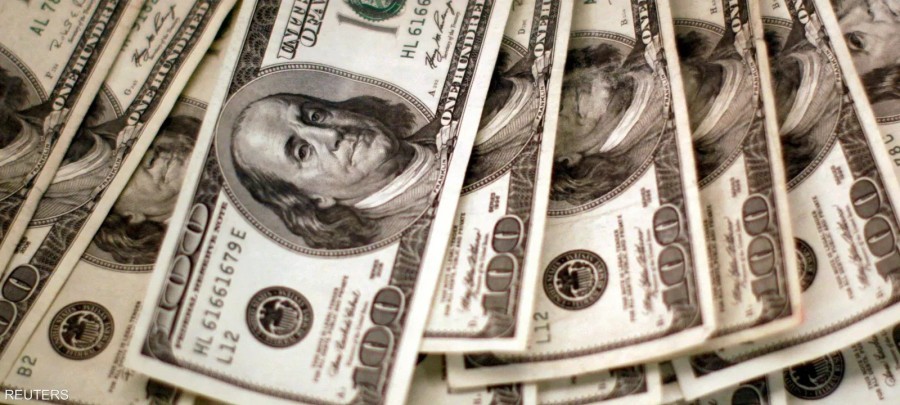


The US dollar dipped slightly on Tuesday, but still retained most of its recent large gains due to changing expectations about Federal Reserve policy following the nomination of a new chairman.
At 12:30 PM Saudi time, the dollar index, which tracks the performance of the US currency against a basket of six other currencies, fell by 0.1% to 97.380, after jumping by 1.5% during the last two trading sessions.
Postponement of the monthly jobs report
The US dollar received a boost at the end of last week after US President Donald Trump nominated Kevin Warsh to be the next Federal Reserve chairman, as the market expects he will be less inclined to push for a rapid interest rate cut than some of the other nominees, while also seeking to shrink the Fed's balance sheet.
The US currency was helped by data released on Monday showing that the US manufacturing sector returned to growth in January, confirming the resilience of the world's largest economy.
The ISM manufacturing index climbed back into expansion territory for the first time in a year, jumping to 52.6 - significantly exceeding expectations and the strongest reading since August 2022, analysts at ING said in a note.
Output and new orders rose sharply, and order backlogs also moved into expansion, all pointing to strong momentum in production going forward.
Morale was slightly affected by a standoff in Washington that led to a partial government shutdown.
As a result, the key monthly jobs report will not be released on Friday, and the job opportunities report scheduled for later in the session has been postponed.
However, a vote in the House of Representatives on extending government funding is expected as early as today, and if it passes, this week's data could be released next week, ING said.
French consumer prices fall
In Europe, the euro/dollar pair rose 0.2% to 1.1812, as the euro rebounded slightly after retreating from the 1.20 level seen last week.
French consumer prices fell 0.3% in January, resulting in a slight annual increase of 0.3%, suggesting that discussions about the risks of deflation may be front and center at the European Central Bank's monetary policy meeting on Thursday.
The European Central Bank is widely expected to keep interest rates steady at 2% for the fifth consecutive meeting.
The further the euro/dollar pair falls, the less likely there will be any comments on the exchange rate at the European Central Bank's monetary policy meeting on Thursday, ING said.
The pound/dollar pair rose 0.1% to 1.3582, as the Bank of England is also expected to keep monetary policy unchanged at its meeting on Thursday.
Australian dollar and Indian rupee rise
In Asia, the dollar/yen pair fell 0.1% to 155.43, as the yen found some support after the pair rose again above the 155.00 level amid uncertainty over whether Japanese authorities would intervene to support the battered currency.
Elsewhere, the dollar/yuan pair fell 0.1% to 6.9367 as a series of strong fixings put the currency at its strongest level since mid-2023, while the Australian dollar/US dollar pair rose 1.3% to 0.7037 after the Reserve Bank of Australia raised interest rates by 25 basis points.
The central bank also raised its growth and inflation forecasts for the year, noting that inflation is now expected to remain above its annual target of 2% to 3% until at least 2027.
The dollar/Indian rupee pair fell 1.3% to 90.074, dropping to its lowest level since mid-January, after the United States and India announced a trade deal on Monday, under which Washington will reduce its tariffs on New Delhi to 18% from 50%.
In return, India will open its markets further and reduce its purchases of Russian oil.